
What the R&D Tax Incentive Data Reveals about Company Failure Rates

Alex Simmons - Co-Founder & CEO, Kashcade
With a background in big-bank product strategy at CommBank and management consulting at Accenture, Alex now works directly with Australian founders to unlock R&D funding at speed. Under his leadership, Kashcade has raised ~$100M in capital, served hundreds of companies, and built a profitable lending business from the ground up.
Our latest internal analysis of the Research and Development Tax Incentive (RDTI) program transparency report data for the financial year 2022-2023 delivers a clear and compelling message: the program is working, and it’s keeping Aussie businesses persisting towards innovation for longer.
The headline finding is unequivocal: companies leveraging the RDTI program aren't just innovating; they’re surviving and thriving at rates significantly above the national average.
Why RDTI is Good for Long-term Innovation
The data from our comprehensive RDTI23 research report, which draws on more than 13,000 RDTI claimants, combining ATO, ASIC, LinkedIn, and public data sources, shows that backing innovation is enabling long-term resilience.
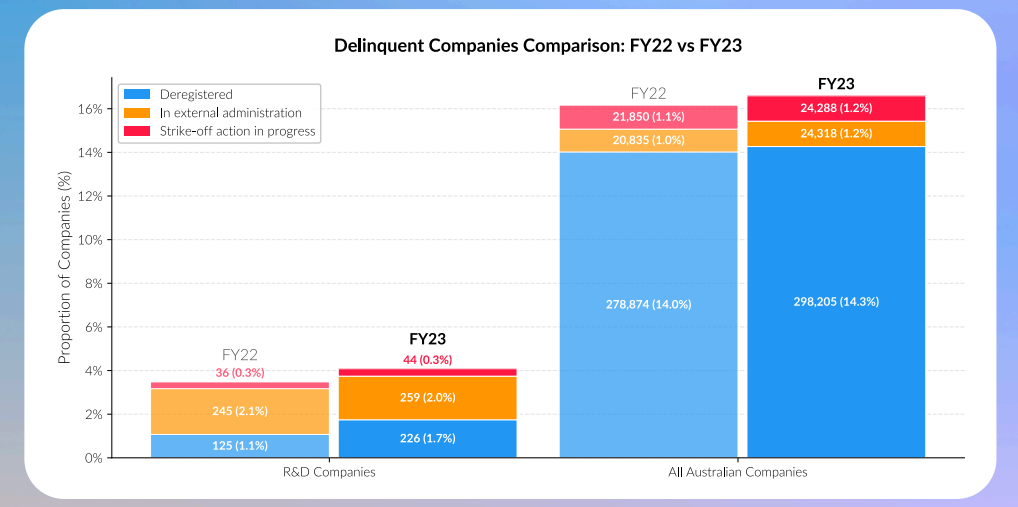
The above graph shows us that companies that tapped into the Research and Development Tax Incentive for FY23 fail at a rate of just 1.7%, compared to 14.3% for companies that didn’t participate. That gap is enormous. It means RDTI-backed companies are around 8.5 times less likely to fail, reflecting the stabilising effect that shared risk and sustained investment in innovation can have on a business’ long-term resilience.
This decreased failure rate represents thousands of jobs saved, countless innovative projects underway, and a substantial layer of stability added to the innovation economy.
The fundamental signal: the government’s support for R&D investment critically offsets the financial risk inherent in innovation, allowing companies to share the burden of their innovation and stay in the game for longer. Good onya, RDTI!
Fuel for the Fire: R&D Investment Surges
The strong survival figures are directly correlated with a continued and expanding commitment to research and development across the participant base.
RDTI Investment Growth at a Glance
In FY23, R&D activity under the program was nothing short of massive. According to our internal analysis of the ATO's RDTI Transparency Report FY 22-23:
- Total R&D Expenditure Claimed: Surged by a massive 42% to an impressive $16.2 billion.
- Economic Multiplier Effect: Estimated at a significant 3.5:1 (meaning every dollar invested generates $3.50 in economic benefit across Australia).
This growth signals that the RDTI is serving as a reliable mechanism for scaling innovative efforts across Australia and ensuring our technology pipelines remains cutting-edge.
The Engine Room: Early-Stage Companies Lead the Charge
The backbone of this innovation success story is early stage companies. These earlier-stage, more agile companies are often at the forefront of technological breakthroughs, but they face high barriers to funding risky, long-cycle R&D projects.
However, they're a significant driver of participation and growth, proving the incentive is hitting its mark:
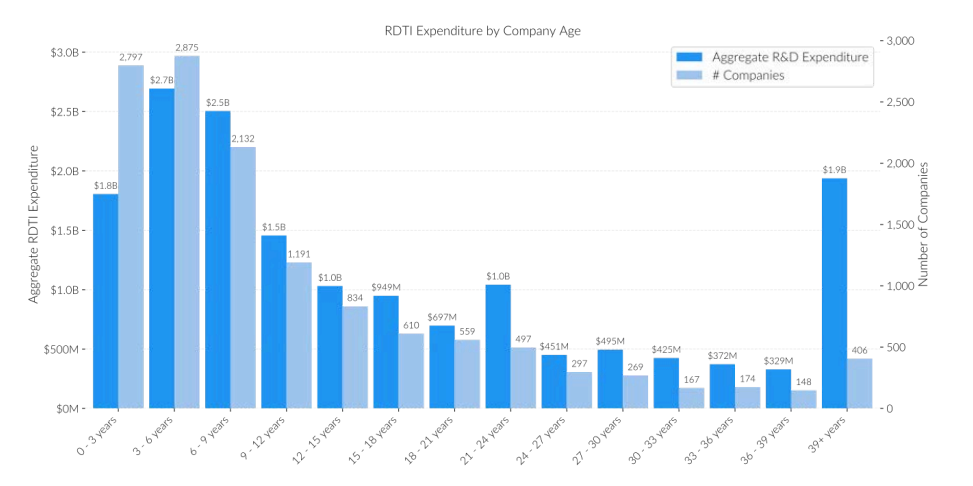
- Early-stage Participation: Companies up to 9 years old account for over 60% of all RDTI participants.
- Significant growth: SMEs with less than $10 million in turnover grew their collective R&D expenditure by 9% in FY23 versus FY22.
The refundable credit component of the RDTI is a lifeline for many of these companies, providing the essential cashflow needed to support their innovation efforts. By supporting these smaller players, the program is effectively de-risking the most dynamic segment of the economy.
A Healthy Influx of New Innovations
While 21% of claimants from FY22 did not return in FY23, the program still saw growth - with 29% new claimants from FY22.

Many of these new entrants are heavily concentrated in critical, future-facing areas, showing the RDTI is channelling investment directly into sectors that will define Australia's future competitiveness, namely:
- Software Development
- Biotechnology
Sectoral Spotlight: Where Innovation is Hottest
While innovation is a necessity everywhere, three sectors recorded significant jumps in R&D participation (by number of companies) during FY23:
These sectoral performances suggest that the RDTI isn't a niche tool; it’s a versatile national asset driving technological advancement and economic differentiation across diverse economic pillars.
Conclusion
The RDTI companies show strong survival rates in FY23 – a 98.3% survival rate – is the ultimate validation of the Research and Development Tax Incentive as an essential tool for national economic policy. The program is demonstrably achieving its goal of fostering innovation-led resilience, fuelling investment, empowering the SME sector, and driving technological leadership.
Sustained support for R&D is the most reliable path to creating a stable, high-value, and future-proof economy. By building on this success, we can ensure that the next generation of Aussie innovators continues to transform challenges into opportunities, securing not just high survival rates, but sustained global leadership.
This article is for general information only and does not constitute financial or tax advice. You should seek professional guidance before making funding or RDTI decisions.