
ATO RDTI Refund Timelines: What Hundreds of Transactions Reveal

Alex Simmons - Co-Founder & CEO, Kashcade
With a background in big-bank product strategy at CommBank and management consulting at Accenture, Alex now works directly with Australian founders to unlock R&D funding at speed.

Patrick Nappa - Co-Founder & CTO, Kashcade
The data analysis and numbers in this piece were produced by Patrick Nappa, Co-Founder & CTO of Kashcade, a former Apple software engineer, University Medallist from the University of Sydney, and Forbes 30 Under 30 Asia honouree (Finance & Venture Capital).
We analysed almost 300 R&D tax return timelines of Kashcade customers to understand how the ATO processes refunds - and what it means for R&D advisors and the companies they support.
Working with hundreds of R&D companies gives a vantage point where we’re able to see patterns in how these businesses grow, spend, and operate.
Through our loan process, we gain visibility into our customers' ATO interactions - primarily to monitor PAYG and GST obligations and confirm when tax returns are lodged and R&D refunds paid out. Over time, that database has grown into something worth exploring and sharing with the ecosystem that is here to support them.
Conversations with R&D advisors have taught us that they are not privy to most of this, as the timing and net result of a tax return tends to sit with the tax agent after the R&D work is handed over. What happens next, and how fast (or slow), is often less clear. We hope this helps shed some light.
A side note: we're still building out our broader dataset, including R&D spend by industry, expenditure breakdowns by category (wages, associate payments, materials, and more), and the proportion of total company spend that goes to R&D. That project is ongoing - let us know if you'd find it valuable, and we'll factor your input into how we shape it.
There’s a long tail in ATO payout times – and bigger refunds do lead to higher latency

Across our full dataset, 80% of refunds landed within 30 days of tax return lodgement, with a median of 15 days. 28% landed within 7 days. For most claimants, the wait is reasonable.
The complication is that these averages mask a wide range of outcomes. The range in our data runs from 6 days to over 400, and there's no reliable way for a claimant to know in advance where they'll fall.
The trend is slowing: Processing slowed materially between FY24 and FY25. The median turnaround grew from 13 to 18 days – a 38% increase in a single year – and the proportion paid within 14 days dropped from 61% to 38%.
The ATO's increased compliance focus on RDTI claims appears to be adding friction to assessments. Advisors setting client expectations based on FY24 experience should update those benchmarks; the typical wait is now meaningfully longer than it was in previous years.
Once it's processed, the timing is almost mechanical
One finding that surprised us: once the ATO marks a return as processed, payment clears in either exactly 3 or 5 business days in virtually every case we observed. There's almost no variation outside that window.
This matters for two reasons. First, it's reassuring the payment leg itself is predictable; second, it gives advisors something concrete to work with when timing their own invoices relative to client cash receipt.
Claim size is the single strongest predictor of how long it takes
Refund size isn't everything, but it's the closest thing we have to a reliable forecasting variable.
Claims under $250k resolved in a median of 10 days. Claims over $1M took a median of 40 days. The relationship isn't perfect, but it's consistent enough to matter when you're setting client expectations.
44% of returns were paid less than lodged - but most reductions are small

Across the returns in our dataset, 44% were paid at a reduced amount relative to what was lodged.
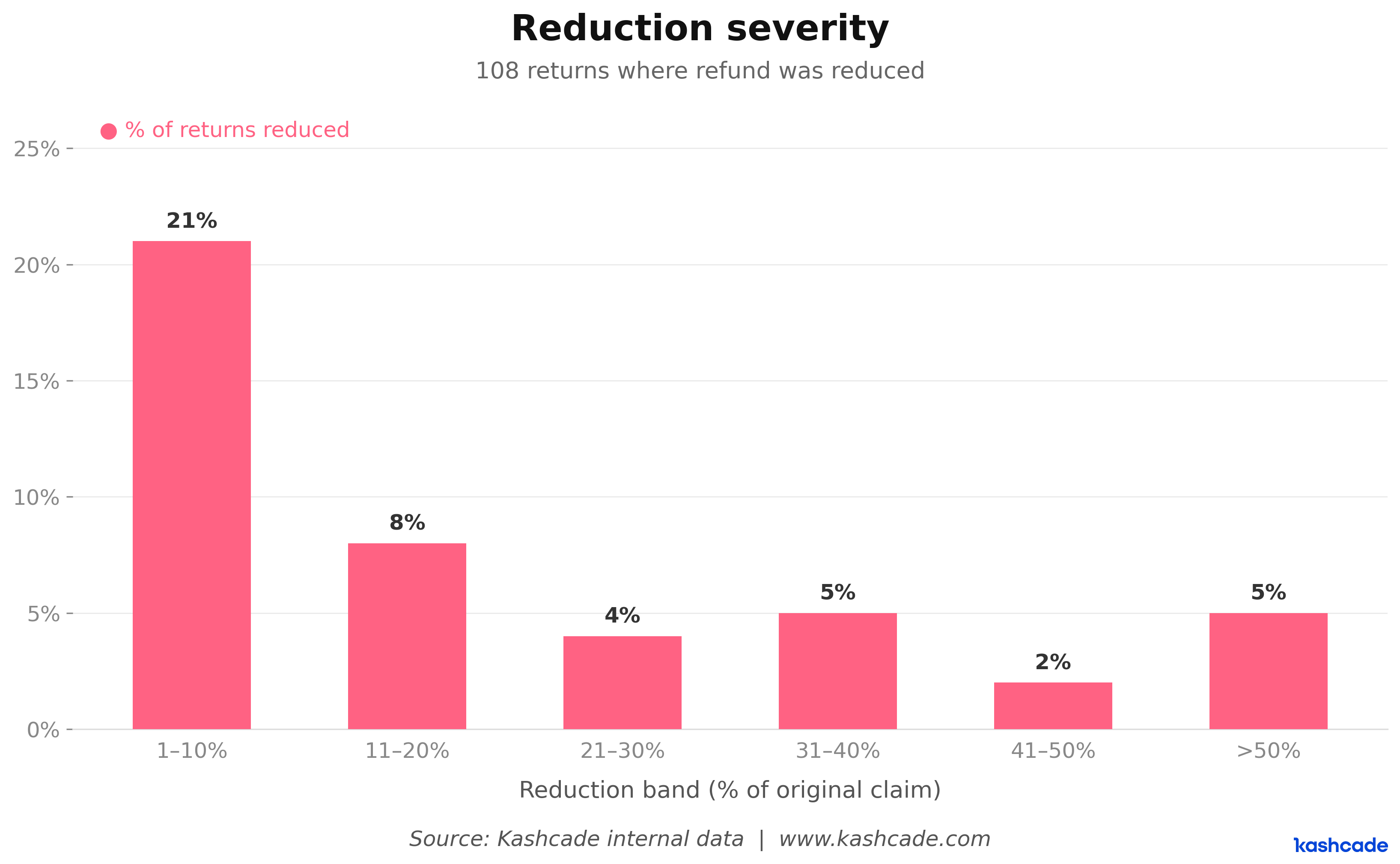
When you look at the severity of reductions, the picture is more nuanced than the 44% headline suggests. Over a fifth of reductions were under 10% of the gross claim – on a median refund of $300k, that's $30k or less. That's consistent with a routine ATO offset of an outstanding PAYG and/or GST balance rather than any dispute over the underlying R&D claim itself.
But the distribution has a meaningful tail. The median reduction was 12%, yet the mean was 19% - pulled upward by a subset of returns where the ATO took significantly more. And for the 5% of returns reduced by 50% or more, the numbers are harder to interpret. In our experience, reductions of that magnitude are sometimes explained by a major outstanding tax balance, or a contested element of the claim.
When to lodge and when to expect payment

The lodgement seasonality data confirms what most advisors already know anecdotally, but the specifics are worth having.
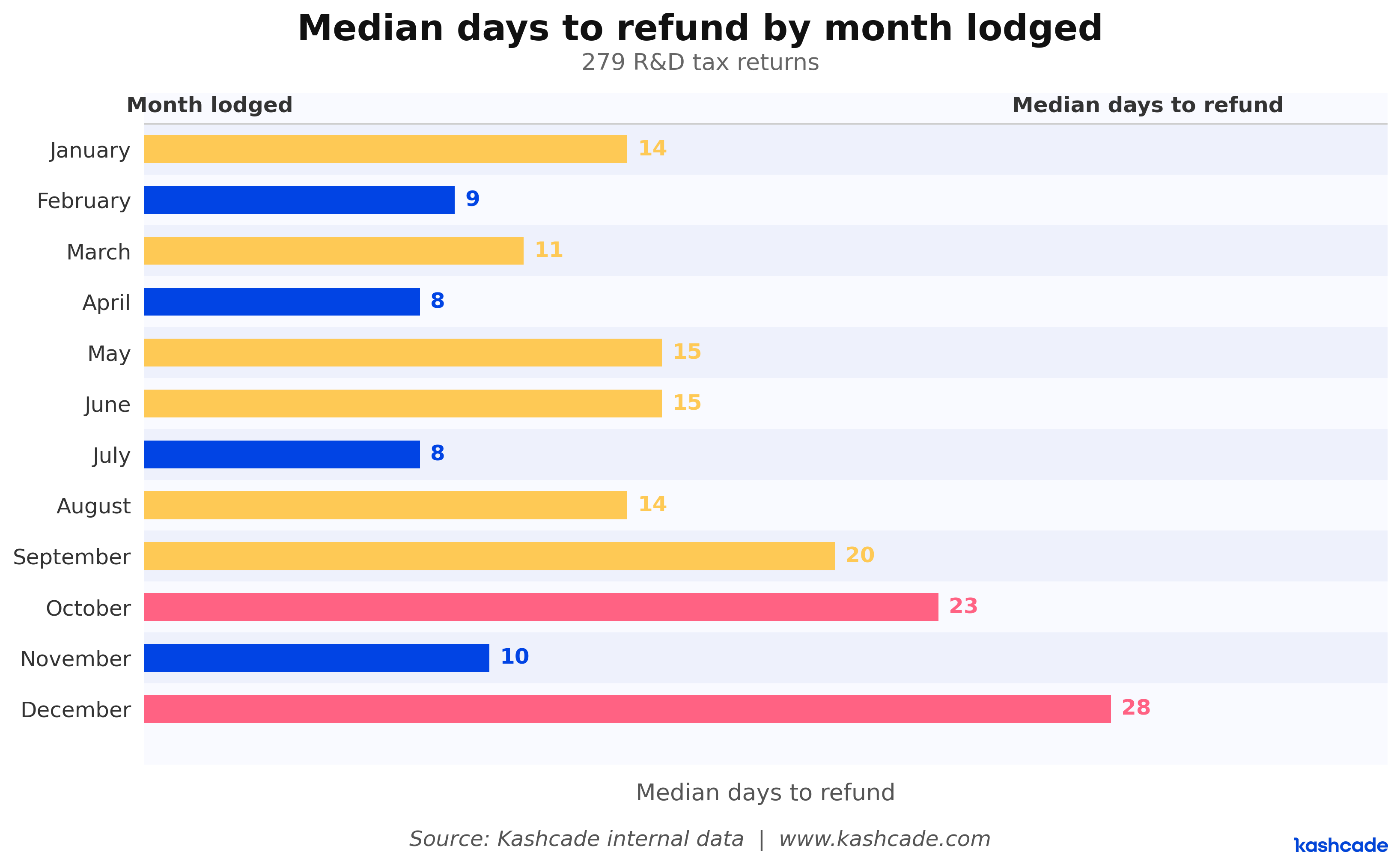
August to November is the clear lodgement peak. Across our dataset, almost 60% of returns were filed in this four-month window, with September alone accounting for 18%; the highest of all months.
Through those peak months, the average (median) time from tax return lodgement to refund receipt varied. Lodgements in August and November were turned around in 14 and 10 days, respectively. If lodged in September and October, turnaround times blew out to between 20 to 23 days. December lodgements saw a much greater latency, with the average turnaround taking 28 days. January lodgements returned to a normal 14 days.
What this means for R&D advisors
A few practical takeaways from everything above:
- The 30-day baseline is still broadly holding – 80% of refunds land within it, but FY25 data suggests the ATO is running slower than the prior year. Update expectations accordingly.
- Claim size is your best planning input. Under $250k: expect under two weeks. Over $1M: factor in six weeks or more.
- Once the ATO marks a return as processed, payment clears in 3 or 5 business days - almost without exception. That's a useful number for timing your own invoices relative to when your client actually has cash in hand.
- Offset risk is underappreciated. 44% of returns in our dataset were paid less than lodged. A proactive conversation about PAYG balances before lodgement will save a harder conversation after.
- And on timing: August is the sweet spot for lodgement. September and October filers should expect three to four weeks, not a fortnight. December lodgers should be told upfront that late January is the realistic outcome.
If it’s useful, we'll keep building on this dataset. If there are specific cuts you'd find useful, please let us know.
Notes on the data: This analysis covers 279 tax returns from Kashcade customers across FY21 through FY25. Through our loan process, we gain visibility into ATO account activity, including lodgement and payment timing, across our portfolio of innovation-led companies. The dataset is not a random sample of all RDTI claimants; it reflects the companies we work with.